WildflowerJS Reactive JS, No BS*

A no-build reactive JavaScript framework, rooted in the web platform.
No build step. No dependencies. No lock-in.

<script src="wildflower.min.js"></script> ...and start building.

Back to Basics

The code you write is 100% web standard code. HTML stays HTML. JavaScript stays JavaScript. CSS stays CSS. No JSX, no templating language, no custom syntax to learn. If you know the web platform, you already know how to use this.

WildflowerJS extends the web platform. It doesn't replace it.

Your Development Simplified

Because you develop with 100% web standards, every tool in your existing chain already understands the code: IDE, browser DevTools, linter, formatter, screen reader, SEO crawler. Nothing to install, no custom file types, no sourcemaps. Save the file, refresh, and your change is live.

Just be a web developer.

Batteries Included: One Mental Model

Router, SSR, stores, computed properties, two-way binding, event modifiers, data pools, and TypeScript types, all built in, all speaking the same language. Learn data-bind once and you know binding everywhere: lists, pools, stores, forms. There's no five-library stack to keep in sync.

One script tag. Everything you need.

<div data-component="counter">
  <span data-bind="count"></span>
  <button data-action="increment">
    +1
  </button>
</div>

<script>
wildflower.component('counter', {
  state: { count: 0 },
  increment() { this.count++ }
})
</script>

How It Works

data-bind connects state to the DOM.

data-action connects events to methods.

this.count++ triggers a precise DOM update.

Mutate state. The DOM updates.

Two Reactivity Modes

data-list for automatic reactivity: mutate state, DOM updates. data-pool for explicit control: plain objects, zero proxy overhead, you say what changed.

Same template syntax. Different performance profile. From interactive forms to per-frame particle systems. You choose the right tradeoff for the job.

Try it. Right-click, inspect this demo. Every dot is a real DOM element.

See full demo →

* Build Step

Zero Toolchain

Modern frameworks ask you to install a compiler, a bundler, a package manager, hundreds of fragile transitive dependencies, and a framework-specific file format, before you write a single line of your application.

WildflowerJS was built starting from a single principle: no build step, no tooling. Ever.

WildflowerJS asks you to add a script tag.

There's no CLI scaffolding step, no config files, no .vue/.jsx/.svelte source format. You don't debug through sourcemaps or wait on a build pipeline. Your project has zero dependencies.

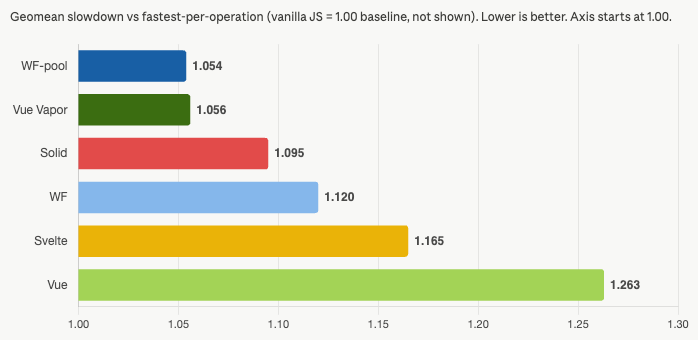
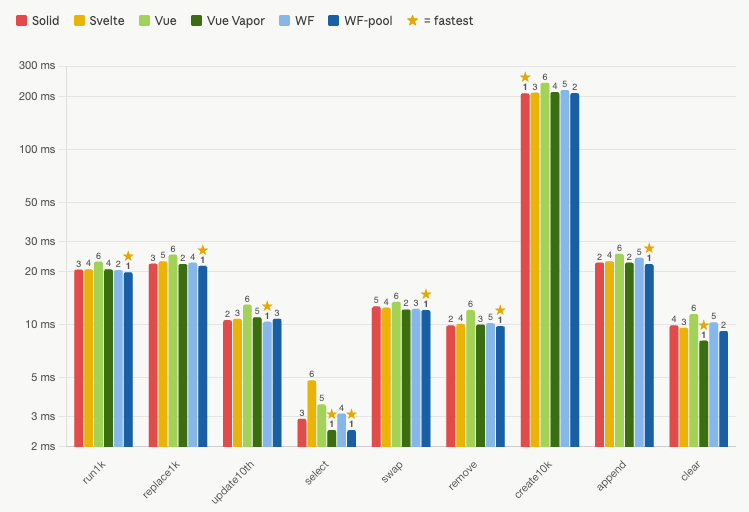
Performance isn't a tradeoff. Build steps optimize bundle delivery, not the runtime work that follows it. WildflowerJS writes directly to the DOM, with no virtual DOM or reconciliation pass between state change and update, so it doesn't need a build step to be fast.

The framework is full-featured without the toolchain: router, SSR, stores, computed properties, transitions, pools. You don't need a toolchain to use any of it.

my-app/
  index.html
  app.js
  style.css
  wildflower.min.js

That's the entire project. No package.json.
No node_modules. No config files. Ship it.

Zero Install. Zero Attack Surface.

Every dependency you install is trust extended to a maintainer you've never met, running scripts on your dev machine and in your CI. A typical React + Vite + UI‑lib setup pulls in 300+ transitive packages before you write a feature.

Each one is a potential intrusion vector. NPM worms, OAuth chains compromising deploy platforms, postinstall hijacking: the supply chain is now where production code gets compromised, not the deploy. And signing isn't a backstop: Mini Shai‑Hulud (May 2026) compromised 170+ packages whose malicious versions carried valid SLSA Build Level 3 provenance, because the attestation came from build infrastructure the worm had already taken over.

WildflowerJS users don't have this attack surface, by construction. There is no npm install, no postinstall script, no transitive package graph. The framework is one file you copy or pin by hash.

As of v1.1, the same holds for building the framework itself. WildflowerJS bundles with a vendored rollup and terser pipeline pulled as three SHA‑512‑pinned tarballs: no npm install, no transitive packages, no postinstall scripts in the build path. The entire toolchain is three files you verify by hash.

Zero dependencies is the absence of a problem the rest of the industry has not properly addressed.

A typical React/Vue project:

  npm install
  ├── hundreds of packages
  ├── from hundreds of maintainers
  ├── postinstall scripts run on install
  └── tens to hundreds of MB of transitive code

WildflowerJS:

  <script src="wildflower.min.js"></script>
  └── 1 file.
      No transitive dependencies.

Zero Lock-in

WildflowerJS works with the DOM, not instead of it. There's no virtual DOM intercepting your code and no compiler rewriting your markup. The render cycle is yours.

That means Leaflet, DataTables, Chart.js, D3, Three.js, any library that touches the DOM, just works. No wrapper packages or framework-specific escape hatches required. Drop in a script tag and use it.

Because your code is standard HTML and JavaScript, you're never locked in. Your skills transfer and your code is more portable. If you outgrow the framework, your knowledge doesn't expire.

This also means your "ecosystem" is all of the world of vanilla JS. Without compromises or hacks.

<!-- Use any library directly -->
<div data-component="map-view">
  <div id="map" style="height: 400px"></div>
</div>
wildflower.component('map-view', {
  state: { lat: 51.505, lng: -0.09 },
  init() {
    // Leaflet works as-is. No wrappers.
    this._map = L.map('map')
      .setView([this.lat, this.lng], 13);
    L.tileLayer('https://{s}.tile.osm.org'
      + '/{z}/{x}/{y}.png').addTo(this._map);
  }
})

Precise Reactivity

When you write this.count++, WildflowerJS updates the single DOM node bound to count. Nothing else is touched. There's no tree diffing or reconciliation pass to figure that out.

This isn't a tradeoff. You get fine-grained updates and a simple mental model. Change a property, the bound element updates. That's the entire reactivity model.

Other frameworks ask you to learn signals, accessors, memos, effects, and subscription lifecycles to achieve what WildflowerJS does with a property assignment.

wildflower.component('dashboard', {
  state: {
    users: 1420,
    status: 'healthy'
  },
  computed: {
    summary() {
      return this.users + ' users, ' + this.status;
    }
  },
  refresh() {
    this.users = 1421;
    // Only the elements bound to 'users'
    // and 'summary' update. Everything
    // else on the page is untouched.
  }
})

One Reactivity Model. Everywhere.

Components, Stores, and Plugins all share the same reactive foundation. State, computed properties, and methods work identically no matter where they live. Learn it once, it works the same way in a UI component, a global store, or a framework plugin.

Other frameworks make you learn a different system for each layer. React components use hooks, but stores need Redux or Zustand, which are completely different APIs. Vue components use reactive data, but Pinia stores have their own patterns. Every layer is a new mental model.

In WildflowerJS, there's one model. A store is a component without a template. A plugin is an entity that extends the framework itself, adding directives, lifecycle hooks, and services. The same this.count++ triggers the same reactivity everywhere.

This unlocks patterns other frameworks can't express. A store can run headless physics simulations with tick(), feeding data into a component that renders it through a pool, all using the same reactive primitives, no glue code required.

// Component: reactive UI
wildflower.component('cart', {
  state: { items: [] },
  computed: {
    total() { return this.items.length; }
  }
})

// Store: global shared state
wildflower.store('user', {
  state: { name: '', role: 'guest' },
  computed: {
    isAdmin() { return this.role === 'admin'; }
  }
})

// Plugin: extends the framework
wildflower.plugin({
  name: 'notifications',
  state: { items: [], unreadCount: 0 },
  computed: {
    hasUnread() { return this.unreadCount > 0; }
  },
  add(msg) { this.items.push(msg); this.unreadCount++; }
})
// Access globally: wildflower.$notifications.add(...)

// Same state. Same computed. Same methods.

Data Pools

Every framework wraps collection items in reactive proxies, whether the item needs it or not. WildflowerJS gives you a choice: data-list for push reactivity (automatic), data-pool for pull reactivity (explicit control, zero proxy overhead).

Pools render plain objects with the same template syntax as lists. Mutate the object, call markDirty(), and only that item updates. Full CRUD, selection, bulk operations, all faster than the push-reactive path.

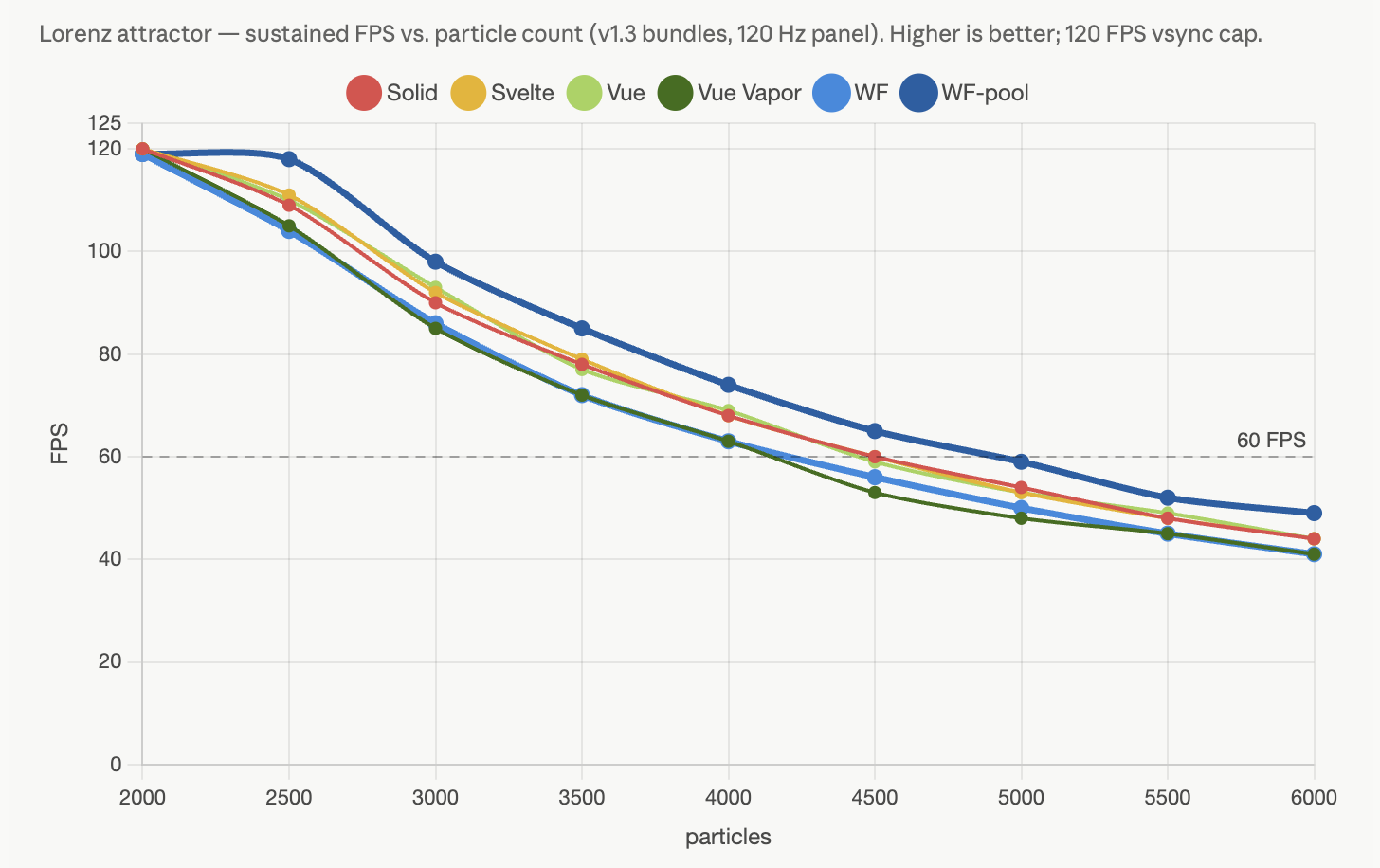
And because pools use pull-based rendering, they scale to simulations, games, particle systems, and data visualizations at native frame rate. Use cases that would choke a virtual DOM. No other framework has anything like this.

<div data-component="user-table">
  <tbody data-pool="users" data-key="id">
    <template>
      <tr>
        <td data-bind="name"></td>
        <td data-bind="status"
            data-bind-class="status === 'active'
              ? 'badge success'
              : 'badge inactive'"></td>
      </tr>
    </template>
  </tbody>
</div>
wildflower.component('user-table', {
  pools: { users: {} },

  init() {
    // Populate: plain objects, no proxies
    data.forEach(u => this.pools.users.add(u));
  },

  // Optional: add tick() and the same pool
  // renders every frame. Same template, same
  // data, different rendering frequency.
  // That's the only difference between a
  // display table and a particle system.
})

Built for AI-Assisted Development

Because WildflowerJS is standard HTML and JavaScript, AI code assistants already know how to write it. There's no custom syntax to hallucinate or compiler quirks to work around. The code an AI generates runs exactly as written, with no build step between generation and execution.

We go further. WildflowerJS ships an AI-optimized reference page with patterns, anti-patterns, and examples designed for code generation context windows. Our llms.txt file follows the llms.txt convention for machine-readable documentation.

And for structured app generation, our Universal App Manifest lets you describe an entire application as a JSON schema (components, state, computed properties, methods, templates) and have an AI generate the working code from the manifest, mediated through framework-specific idiom files.

You: "Build me a todo app with
WildflowerJS"

AI reads llms.txt or ai-assistant.html
     ↓
Generates standard HTML + JS
     ↓
<div data-component="todo-app">
  <input data-model="newItem">
  <button data-action="addItem">
    Add
  </button>
  <ul data-list="items">
    <template>
      <li data-bind="text"></li>
    </template>
  </ul>
</div>
     ↓
Open in your browser. It works, and you can read and understand the code.

Computed Properties

Derive reactive values from state with automatic dependency tracking and efficient caching.

💡 Key Concept: Computed properties automatically recalculate when their dependencies change, providing efficient derived state management.

Basic Computed Properties

Define computed properties in your component definition. They automatically track dependencies and update when dependent state changes:

<div data-component="user-profile-computed">
    <div class="row">
        <div class="col-md-6">
            <h5>Input Fields</h5>
            <div class="mb-3">
                <label class="form-label">First Name:</label>
                <input type="text" class="form-control" data-model="firstName" placeholder="Enter first name">
            </div>
            <div class="mb-3">
                <label class="form-label">Last Name:</label>
                <input type="text" class="form-control" data-model="lastName" placeholder="Enter last name">
            </div>
            <div class="mb-3">
                <label class="form-label">Username:</label>
                <input type="text" class="form-control" data-model="username" placeholder="Optional username">
            </div>
        </div>
        
        <div class="col-md-6">
            <h5>Computed Values</h5>
            <div class="card"><div class="card-body">
                <p><strong>Full Name:</strong> <span data-bind="fullName" class="text-primary"></span></p>
                <p><strong>Initials:</strong> <span data-bind="initials" class="badge bg-secondary"></span></p>
                <p><strong>Display Name:</strong> <span data-bind="displayName" class="text-success"></span></p>
                <p><strong>Name Length:</strong> <span data-bind="nameLength"></span> characters</p>
                <p><strong>Has Full Name:</strong> <span data-bind="hasFullName" class="badge"></span></p>
            </div></div>
        </div>
    </div>
    
    <div class="mt-3">
        <button class="btn btn-primary btn-sm me-2" data-action="loadSample">
            Load Sample Data
        </button>
        <button class="btn btn-secondary btn-sm me-2" data-action="clearAll">
            Clear All
        </button>
        <button class="btn btn-info btn-sm" data-action="randomize">
            Randomize
        </button>
    </div>
</div>
wildflower.component('user-profile-computed', {
    state: {
        firstName: 'John',
        lastName: 'Doe',
        username: ''
    },
    
    computed: {
        // Basic computed property - combines state values
        fullName() {
            return `${this.firstName} ${this.lastName}`.trim()
        },

        // Computed property with string manipulation
        initials() {
            const first = this.firstName.charAt(0).toUpperCase()
            const last = this.lastName.charAt(0).toUpperCase()
            return `${first}${last}`
        },
        
        // Computed property using other computed properties
        displayName() {
            const full = this.fullName
            return full || this.username || 'Anonymous User'
        },
        
        // Computed property with calculation
        nameLength() {
            return this.fullName.length
        },
        
        // Boolean computed property
        hasFullName() {
            return this.firstName && this.lastName
        }
    },
    
    loadSample() {
        this.firstName = 'Alice'
        this.lastName = 'Johnson'
        this.username = 'alice.j'
    },

    clearAll() {
        this.firstName = ''
        this.lastName = ''
        this.username = ''
    },

    randomize() {
        const firstNames = ['Emma', 'Oliver', 'Sophia', 'William', 'Ava', 'James']
        const lastNames = ['Smith', 'Johnson', 'Brown', 'Taylor', 'Anderson', 'Wilson']

        this.firstName = firstNames[Math.floor(Math.random() * firstNames.length)]
        this.lastName = lastNames[Math.floor(Math.random() * lastNames.length)]
        this.username = `${this.firstName.toLowerCase()}.${this.lastName.toLowerCase()}`
    }
})
Live Preview

Dependency Tracking & Complex Calculations

WildflowerJS automatically tracks dependencies and updates computed properties when dependent state changes:

<div data-component="shopping-cart-computed">
    <div class="mb-3">
        <button class="btn btn-success btn-sm me-2" data-action="addItem">
            Add Random Item
        </button>
        <button class="btn btn-warning btn-sm me-2" data-action="applyDiscount">
            Toggle 10% Discount
        </button>
        <button class="btn btn-info btn-sm me-2" data-action="changeTaxRate">
            Change Tax Rate
        </button>
        <button class="btn btn-danger btn-sm" data-action="clearCart">
            Clear Cart
        </button>
    </div>
    
    <div data-show="hasItems">
        <h5>Cart Items</h5>
        <div data-list="items" class="mb-3">
            <template>
                <div class="d-flex justify-content-between align-items-center mb-2 p-2 border rounded">
                    <div class="flex-grow-1">
                        <strong data-bind="name"></strong>
                        <small class="text-muted d-block">$<span data-bind="price"></span> each</small>
                    </div>
                    <div class="d-flex align-items-center">
                        <input type="number" 
                               data-model="quantity" 
                               min="1" 
                               max="10" 
                               class="form-control me-2" 
                               style="width: 70px;">
                        <span class="text-nowrap">
                            = $<span data-bind="lineTotal" class="fw-bold"></span>
                        </span>
                        <button class="btn btn-sm btn-danger ms-2" data-action="removeItem">
                            ×
                        </button>
                    </div>
                </div>
            </template>
        </div>
        
        <div class="border-top pt-3">
            <div class="row">
                <div class="col-md-6">
                    <p><strong>Item Count:</strong> <span data-bind="itemCount"></span></p>
                    <p><strong>Total Quantity:</strong> <span data-bind="totalQuantity"></span></p>
                    <p><strong>Average Item Price:</strong> $<span data-bind="averagePrice"></span></p>
                </div>
                <div class="col-md-6">
                    <p><strong>Subtotal:</strong> $<span data-bind="subtotal"></span></p>
                    <p data-show="hasDiscount"><strong>Discount (10%):</strong> -$<span data-bind="discountAmount"></span></p>
                    <p><strong>Tax (<span data-bind="taxRate"></span>%):</strong> $<span data-bind="tax"></span></p>
                    <p class="fs-5 text-success"><strong>Total: $<span data-bind="total"></span></strong></p>
                </div>
            </div>
        </div>
    </div>
    
    <div data-show="!hasItems" class="text-center text-muted py-4">
        <p>Your cart is empty. Add some items to see computed properties in action!</p>
    </div>
</div>
wildflower.component('shopping-cart-computed', {
    state: {
        items: [
            { name: 'Widget A', price: 19.99, quantity: 2 },
            { name: 'Widget B', price: 29.99, quantity: 1 }
        ],
        taxRate: 8.5,
        hasDiscount: false
    },
    
    computed: {
        // Item-level computed property for line totals
        lineTotal() {
            return (this.price * this.quantity).toFixed(2)
        },
        
        // Component-level computed properties
        hasItems() {
            return this.items.length > 0
        },

        itemCount() {
            return this.items.length
        },

        totalQuantity() {
            return this.items.reduce((sum, item) => sum + item.quantity, 0)
        },

        subtotal() {
            return this.items.reduce((sum, item) => {
                return sum + (item.price * item.quantity)
            }, 0).toFixed(2)
        },

        averagePrice() {
            if (this.items.length === 0) return '0.00'
            const total = this.items.reduce((sum, item) => sum + item.price, 0)
            return (total / this.items.length).toFixed(2)
        },

        discountAmount() {
            return this.hasDiscount ? (this.subtotal * 0.1).toFixed(2) : '0.00'
        },

        taxableAmount() {
            const subtotal = parseFloat(this.subtotal)
            const discount = parseFloat(this.discountAmount)
            return subtotal - discount
        },

        tax() {
            return (this.taxableAmount * (this.taxRate / 100)).toFixed(2)
        },

        total() {
            return (this.taxableAmount + parseFloat(this.tax)).toFixed(2)
        }
    },
    
    addItem() {
        const products = [
            { name: 'Gadget Pro', price: 49.99 },
            { name: 'Super Tool', price: 24.99 },
            { name: 'Magic Device', price: 79.99 },
            { name: 'Wonder Item', price: 34.99 }
        ]
        
        const product = products[Math.floor(Math.random() * products.length)]
        this.items.push({
            ...product,
            quantity: Math.floor(Math.random() * 3) + 1
        })
    },

    removeItem(event, element, details) {
        this.items.splice(details.index, 1)
    },

    applyDiscount() {
        this.hasDiscount = !this.hasDiscount
    },

    changeTaxRate() {
        const rates = [5.0, 8.5, 10.0, 12.5]
        const currentIndex = rates.indexOf(this.taxRate)
        const nextIndex = (currentIndex + 1) % rates.length
        this.taxRate = rates[nextIndex]
    },

    clearCart() {
        this.items = []
        this.hasDiscount = false
    }
})
Live Preview

Caching and Performance

Computed properties are cached and only recalculate when their dependencies change:

✅ Performance Benefits:
  • Computed values are cached until dependencies change
  • Expensive calculations run only when necessary
  • Automatic dependency tracking prevents unnecessary updates
  • Multiple bindings to the same computed property share the cached result
<div data-component="performance-demo">
    <div class="row">
        <div class="col-md-6">
            <h5>Array Configuration</h5>
            <div class="mb-3">
                <label class="form-label">Array Size: <span data-bind="arraySize"></span></label>
                <input type="range" 
                       class="form-range" 
                       data-model="arraySize" 
                       min="100" 
                       max="5000" 
                       step="100">
            </div>
            
            <div class="mb-3">
                <button class="btn btn-primary btn-sm me-2" data-action="regenerateNumbers">
                    Regenerate Numbers
                </button>
                <button class="btn btn-secondary btn-sm me-2" data-action="addRandomNumber">
                    Add Random Number
                </button>
                <button class="btn btn-warning btn-sm" data-action="multiplyArray">
                    Double Array Size
                </button>
            </div>
            
            <div class="mb-3">
                <h6>Caching Test</h6>
                <p class="small text-muted">These buttons access the same computed properties multiple times. 
                   Notice the calculation count doesn't increase because values are cached.</p>
                <button class="btn btn-info btn-sm me-2" data-action="accessSum">
                    Access Sum (Cached)
                </button>
                <button class="btn btn-info btn-sm" data-action="accessStats">
                    Access All Stats (Cached)
                </button>
            </div>
        </div>
        
        <div class="col-md-6">
            <h5>Computed Statistics</h5>
            <div class="card"><div class="card-body">
                <p><strong>Array Length:</strong> <span data-bind="actualLength"></span></p>
                <p><strong>Sum:</strong> <span data-bind="sum" class="text-primary"></span></p>
                <p><strong>Average:</strong> <span data-bind="average" class="text-success"></span></p>
                <p><strong>Min Value:</strong> <span data-bind="minMax.min"></span></p>
                <p><strong>Max Value:</strong> <span data-bind="minMax.max"></span></p>
                <p><strong>Standard Deviation:</strong> <span data-bind="standardDeviation"></span></p>
            </div></div>
            
            <div class="mt-3 p-2 bg-light rounded">
                <h6>Performance Metrics</h6>
                <p class="mb-1"><strong>Sum Calculations:</strong> <span data-bind="calcCounts.sum" class="badge bg-primary"></span></p>
                <p class="mb-1"><strong>MinMax Calculations:</strong> <span data-bind="calcCounts.minMax" class="badge bg-success"></span></p>
                <p class="mb-0"><strong>StdDev Calculations:</strong> <span data-bind="calcCounts.stdDev" class="badge bg-info"></span></p>
                <small class="text-muted">These counters show how many times expensive calculations actually run.</small>
            </div>
        </div>
    </div>
</div>
wildflower.component('performance-demo', {
    state: {
        arraySize: 5,
        numbers: [],
        calcCounts: {
            sum: 0,
            minMax: 0,
            stdDev: 0
        }
    },
    
    computed: {
        actualLength() {
            return this.numbers.length
        },

        // Expensive calculation - only runs when numbers array changes
        sum() {
            return this.numbers.reduce((a, b) => a + b, 0)
        },

        // Uses cached sum value - no additional calculation
        average() {
            return this.numbers.length > 0
                ? (this.sum / this.numbers.length).toFixed(2)
                : 0
        },
        
        // Another expensive calculation with its own caching
        minMax() {
            // Simple cascade breaker - track call frequency
            if (!this._cascadeBreaker) this._cascadeBreaker = {};
            if (!this._cascadeBreaker.minMax) this._cascadeBreaker.minMax = { calls: 0, lastReset: Date.now() };
            
            const now = Date.now();
            const breaker = this._cascadeBreaker.minMax;
            
            // Reset counter every 100ms
            if (now - breaker.lastReset > 100) {
                breaker.calls = 0;
                breaker.lastReset = now;
            }
            
            breaker.calls++;
            
            // Enhanced diagnostic logging

            // If called more than 20 times in 100ms, return cached result
            if (breaker.calls > 20) {
                console.log('🟠 CASCADE BREAKER: minMax called too frequently, returning cached result');
                return this._cascadeBreaker.minMax.lastResult || { min: 0, max: 0 };
            }
            
            const numbers = this.numbers;
            if (numbers.length === 0) {
                return { min: 0, max: 0 };
            }

            let min = numbers[0];
            let max = numbers[0];

            for (let i = 1; i < numbers.length; i++) {
                const num = numbers[i];
                if (num < min) min = num;
                if (num > max) max = num;
            }

            const result = { min, max };
            this._cascadeBreaker.minMax.lastResult = result;
            return result;
        },
        
        // Very expensive calculation - uses cached sum for efficiency
        standardDeviation() {
            const numbers = this.numbers
              if (numbers.length <= 1) return '0.00'

              const mean = this.sum / numbers.length
              let sumSquaredDifferences = 0

              for (let i = 0; i < numbers.length; i++) {
                const difference = numbers[i] - mean
                sumSquaredDifferences += difference * difference
              }

              const variance = sumSquaredDifferences / numbers.length

              return Math.sqrt(variance).toFixed(2)
        }
    },
    
    // Manual tracking methods for demonstration
    trackSumCalculation() {
        this.calcCounts = {
            ...this.calcCounts,
            sum: this.calcCounts.sum + 1
        }
    },

    trackMinMaxCalculation() {
        this.calcCounts = {
            ...this.calcCounts,
            minMax: this.calcCounts.minMax + 1
        }
    },

    trackStdDevCalculation() {
        this.calcCounts = {
            ...this.calcCounts,
            stdDev: this.calcCounts.stdDev + 1
        }
    },
    
    
    init() {
        this.regenerateNumbers()
    },
    
    regenerateNumbers() {
        console.log('Regenerating array - computed properties will recalculate')
        this.numbers = Array.from(
            { length: parseInt(this.arraySize) },
            () => Math.floor(Math.random() * 100)
        )
        // No automatic tracking - only when user clicks buttons
    },

    addRandomNumber() {
        this.numbers = [...this.numbers, Math.floor(Math.random() * 100)]
    },

    multiplyArray() {
        // Double the array by adding more random numbers
        const currentLength = this.numbers.length
        const newNumbers = Array.from(
            { length: currentLength },
            () => Math.floor(Math.random() * 100)
        )
        this.numbers = [...this.numbers, ...newNumbers]
        this.arraySize = this.numbers.length
    },

    accessSum() {
        // Access the computed sum multiple times
        // Notice the calculation count doesn't increase because it's cached
        console.log('Accessing cached sum:', this.sum)
        console.log('Accessing cached sum again:', this.sum)
        console.log('And again:', this.sum)
        // Manually track this access for demo purposes
        this.trackSumCalculation()
    },

    accessStats() {
        // Access multiple computed properties
        // Each is calculated only once and then cached
        console.log('Stats - Sum:', this.sum)
        console.log('Stats - Average:', this.average)
        console.log('Stats - Min:', this.minValue)
        console.log('Stats - Max:', this.maxValue)
        console.log('Stats - StdDev:', this.standardDeviation)
        // Manually track these accesses for demo purposes
        this.trackSumCalculation()
        this.trackMinMaxCalculation()
        this.trackStdDevCalculation()
    }
})
Live Preview

Computed Properties in Templates

Use computed properties in data binding by name. No prefix needed. WildflowerJS automatically detects computed properties:

💡 Tip: Computed properties resolve by bare name. Just use data-bind="fullName". No special syntax needed.
⚠️ Precedence Rule: If both state and computed have a property with the same name, the computed property takes precedence. This allows computed properties to "override" or transform state values when needed.

Computed Properties in Expressions

🚀 Powerful Feature: Computed properties are automatically merged into the expression namespace alongside state properties. This means you can use computed values directly in any expression: conditionals, ternaries, string concatenation, comparisons, and more.

Unlike some frameworks where computed values require special syntax or function calls, WildflowerJS treats computed properties as first-class citizens:

wildflower.component('user-dashboard', {
    state: {
        firstName: 'Alice',
        lastName: 'Smith',
        items: [1, 2, 3],
        threshold: 5
    },
    computed: {
        fullName() { return `${this.firstName} ${this.lastName}`; },
        itemCount() { return this.items.length; },
        hasItems() { return this.items.length > 0; },
        isOverThreshold() { return this.items.length > this.threshold; }
    }
});
<!-- Computed values work directly in expressions -->

<!-- String concatenation with computed + state -->
<p data-bind="fullName + ' has ' + itemCount + ' items'"></p>

<!-- Ternary expressions mixing computed and state -->
<p data-bind="hasItems ? 'You have ' + itemCount + ' items' : 'No items yet'"></p>

<!-- Boolean logic in conditionals -->
<div data-show="hasItems && itemCount > 2">Many items!</div>
<div data-show="isOverThreshold || itemCount === 0">Edge case</div>

<!-- Computed values in comparisons -->
<span data-bind="itemCount >= threshold ? 'At capacity' : 'Room for more'"></span>

<!-- Computed in class bindings -->
<div data-bind-class="{ 'has-content': hasItems, 'empty': !hasItems, 'over-limit': isOverThreshold }"></div>

<!-- Computed in style bindings -->
<div data-bind-style="{ opacity: hasItems ? '1' : '0.5' }"></div>

This is comparable to Vue's computed + template expressions, Svelte 5's $derived, and Solid's createMemo, but without requiring a build step or special syntax. The computed values simply exist as variables in your expressions.

Binding Type Syntax Description
Text Content data-bind="propertyName" Display computed value as text
HTML Content data-bind-html="propertyName" Insert computed HTML content
Class Binding data-bind-class="className" Set CSS classes from computed values
Style Binding data-bind-style="styleName" Set inline styles from computed objects
Conditionals data-show="isVisible" Show/hide based on computed boolean
Lists data-list="filteredItems" Render computed arrays

Advanced Patterns

Advanced Computed Patterns

Explore advanced patterns like chaining, external dependencies, and computed arrays:

<div>
    <!-- Task Manager Component -->
    <div data-component="task-manager" class="mb-4">
        <div class="row">
            <div class="col-md-6">
                <h5>Task Management</h5>
                
                <div class="mb-3">
                    <input type="text" 
                           class="form-control mb-2" 
                           data-model="newTaskText" 
                           placeholder="Add a new task...">
                    <button class="btn btn-primary btn-sm me-2" data-action="addTask">
                        Add Task
                    </button>
                    <button class="btn btn-secondary btn-sm" data-action="addSampleTasks">
                        Add Sample Tasks
                    </button>
                </div>
                
                <div class="mb-3">
                    <label class="form-label">Filter Tasks:</label>
                    <select class="form-select" data-model="currentFilter">
                        <option value="all">All Tasks</option>
                        <option value="active">Active Only</option>
                        <option value="completed">Completed Only</option>
                        <option value="priority">High Priority</option>
                    </select>
                </div>
                
                <div class="mb-3">
                    <label class="form-label">Sort By:</label>
                    <select class="form-select" data-model="sortBy">
                        <option value="created">Date Created</option>
                        <option value="priority">Priority</option>
                        <option value="alphabetical">Alphabetical</option>
                    </select>
                </div>
            </div>
            
            <div class="col-md-6">
                <h5>Computed Statistics</h5>
                <div class="card"><div class="card-body">
                    <p><strong>Total Tasks:</strong> <span data-bind="totalTasks"></span></p>
                    <p><strong>Active Tasks:</strong> <span data-bind="activeTasks"></span></p>
                    <p><strong>Completed:</strong> <span data-bind="completedTasks"></span></p>
                    <p><strong>Completion Rate:</strong> <span data-bind="completionRate"></span>%</p>
                    <p><strong>High Priority:</strong> <span data-bind="highPriorityCount"></span></p>
                    <p><strong>Status:</strong> <span data-bind="statusMessage" class="badge bg-info"></span></p>
                </div></div>
            </div>
        </div>
        
        <h5>Filtered & Sorted Tasks (<span data-bind="filteredTaskCount"></span> shown)</h5>
        <div data-list="sortedAndFilteredTasks" class="mb-3">
            <template>
                <div class="d-flex align-items-center mb-2 p-2 border rounded" 
                     data-bind-class="completed ? 'bg-light text-muted' : ''">
                    <input type="checkbox" 
                           class="form-check-input me-2" 
                           data-model="completed">
                    <div class="flex-grow-1">
                        <span data-bind="text"></span>
                        <small class="text-muted d-block">
                            Priority: <span data-bind="priority"></span> | 
                            Created: <span data-bind="formattedDate"></span>
                        </small>
                    </div>
                    <span data-bind-class="priorityBadgeClass" class="badge me-2">
                        <span data-bind="priority"></span>
                    </span>
                    <button class="btn btn-sm btn-danger" data-action="removeTask">×</button>
                </div>
            </template>
        </div>
        
        <div data-show="noTasksVisible" class="text-center text-muted py-3">
            No tasks match the current filter.
        </div>
    </div>
</div>
wildflower.component('task-manager', {
    state: {
        tasks: [],
        newTaskText: '',
        currentFilter: 'all',
        sortBy: 'created'
    },
    
    computed: {
        // Basic computed properties
        totalTasks() {
            return this.tasks.length
        },

        activeTasks() {
            return this.tasks.filter(task => !task.completed).length
        },

        completedTasks() {
            return this.tasks.filter(task => task.completed).length
        },

        highPriorityCount() {
            return this.tasks.filter(task => task.priority === 'high').length
        },

        // Chained computed properties
        completionRate() {
            return this.totalTasks > 0
                ? Math.round((this.completedTasks / this.totalTasks) * 100)
                : 0
        },

        statusMessage() {
            if (this.totalTasks === 0) return 'No tasks'
            if (this.completionRate === 100) return 'All complete!'
            if (this.completionRate >= 75) return 'Almost done!'
            if (this.completionRate >= 50) return 'Good progress'
            return 'Getting started'
        },

        // Computed array filtering
        filteredTasks() {
            const filter = this.currentFilter
            const tasks = this.tasks
            
            switch (filter) {
                case 'active':
                    return tasks.filter(task => !task.completed)
                case 'completed':
                    return tasks.filter(task => task.completed)
                case 'priority':
                    return tasks.filter(task => task.priority === 'high')
                default:
                    return tasks
            }
        },
        
        // Computed array sorting (depends on filteredTasks)
        sortedAndFilteredTasks() {
            const tasks = [...this.filteredTasks]
            const sortBy = this.sortBy
            
            switch (sortBy) {
                case 'priority':
                    const priorityOrder = { 'high': 3, 'medium': 2, 'low': 1 }
                    return tasks.sort((a, b) => priorityOrder[b.priority] - priorityOrder[a.priority])
                case 'alphabetical':
                    return tasks.sort((a, b) => a.text.localeCompare(b.text))
                default: // created
                    return tasks.sort((a, b) => new Date(b.createdAt) - new Date(a.createdAt))
            }
        },
        
        filteredTaskCount() {
            return this.filteredTasks.length
        },

        noTasksVisible() {
            return this.sortedAndFilteredTasks.length === 0
        },
        
        // Item-level computed properties
        formattedDate() {
            return new Date(this.createdAt).toLocaleDateString()
        },
        
        priorityBadgeClass() {
            const classes = {
                'high': 'bg-danger',
                'medium': 'bg-warning',
                'low': 'bg-success'
            }
            return classes[this.priority] || 'bg-secondary'
        }
    },
    
    addTask() {
        const text = this.newTaskText.trim()
        if (!text) return

        const priorities = ['low', 'medium', 'high']

        this.tasks.push({
            text: text,
            completed: false,
            priority: priorities[Math.floor(Math.random() * priorities.length)],
            createdAt: new Date().toISOString()
        })

        this.newTaskText = ''
    },
    
    addSampleTasks() {
        const sampleTasks = [
            { text: 'Complete project documentation', priority: 'high' },
            { text: 'Review pull requests', priority: 'medium' },
            { text: 'Update dependencies', priority: 'low' },
            { text: 'Fix critical bug in production', priority: 'high' },
            { text: 'Plan team meeting', priority: 'medium' }
        ]
        
        sampleTasks.forEach(task => {
            this.tasks.push({
                ...task,
                completed: Math.random() > 0.7,
                createdAt: new Date(Date.now() - Math.random() * 7 * 24 * 60 * 60 * 1000).toISOString()
            })
        })
    },
    
    removeTask(event, element, details) {
        this.tasks.splice(details.index, 1)
    }
})
Live Preview

Best Practices

✅ Do
  • Keep computed properties pure (no side effects)
  • Use computed properties for derived state
  • Cache expensive calculations in computed properties
  • Use descriptive names for computed properties
  • Return consistent data types
  • Track side effects outside computed properties
  • Read all potentially-relevant state fields eagerly before any conditional logic (see callout below)
❌ Don't
  • Modify state within computed properties
  • Make API calls in computed properties
  • Use computed properties for actions/events
  • Create circular dependencies
  • Access DOM elements directly
  • Update reactive state synchronously in computed properties

Eager dependency reading for conditional computeds

When a computed reads state behind a conditional (&&, ||, ternary, if/return), eagerly destructure all potentially-relevant fields at the top of the function before any branching. The dependency tracker only records reads that actually execute, so a short-circuited read never gets tracked, and the binding silently won't re-evaluate when that untracked field changes.

⚠️ The short-circuit gotcha
// ❌ Risky: the right side of && only reads when the left is truthy.
// If openField is null on first evaluation, openId is never read and
// never tracked. Later, when only openId changes, the binding misses
// the update.
computed: {
    isOpen(item) {
        const s = this.state;
        return s.openField === 'status' && s.openId === item.id;
    }
}
✅ Eager-read pattern
// ✅ Read both fields up front. Both end up tracked as deps,
// regardless of which value would short-circuit the && later.
computed: {
    isOpen(item) {
        const s = this.state;
        const f = s.openField;   // always read; always tracked
        const id = s.openId;     // always read; always tracked
        return f === 'status' && id === item.id;
    }
}

The symptom of forgetting this is usually non-deterministic UI behavior: the binding wakes up for some state-change sequences and silently misses others. See Conditional reads and dep tracking for the underlying mechanism. This same pattern applies to all runtime-proxy reactive systems (Vue, Solid, MobX, Preact Signals).

Avoiding Circular Dependencies

One common pitfall is creating circular dependencies when computed properties modify state that they also depend on:

⚠️ Circular Dependency Example
// ❌ Bad - Creates infinite loop
computed: {
    expensiveCalculation() {
        this.calculationCount++  // Modifies state!
        return this.data.reduce((a, b) => a + b, 0)
    }
}

// State binding triggers reactivity
<span data-bind="calculationCount"></span>

This creates an endless loop: computed property runs → modifies state → triggers reactivity → computed property runs again.

✅ Solution: External Tracking
// ✅ Good - Track side effects separately
computed: {
    expensiveCalculation() {
        this.trackCalculation('expensive')  // External method
        return this.data.reduce((a, b) => a + b, 0)
    }
},

trackCalculation(type) {
    // Use requestAnimationFrame to avoid circular dependencies
    requestAnimationFrame(() => {
        this.calculationCounts[type]++
    })
}

This approach maintains the educational value while preventing infinite loops by deferring state updates to the next frame.